Zion National Park Tickets, Fees and Permits: Entrance Passes, Angels Landing and The Narrows
There is no timed ticket and no reservation to visit Zion National Park. You do not need a permit or reservation to enter the park, and you do not need one to ride the free shuttle. What you do need is an entrance pass: on the National Park Service’s fee page, updated June 6, 2026, that is $35.00 for a private vehicle, $30.00 for a motorcycle and $20.00 per person on foot or by bike, with youth 15 and under free. Standard passes are valid for 7 days.
There is one large extra for overseas visitors: each non-US resident aged 16 and older pays a $100 nonresident fee on top of the standard entrance fee, unless they are admitted with an Annual or America the Beautiful Pass.
Beyond the entrance pass, permits matter for only a handful of things, but they are the things many people come for: the chains on Angels Landing, the top-down hike through The Narrows, the Subway and technical canyoneering. This guide sets out what each one costs, when to apply, and what you can do without one.
What needs a permit and what does not
The National Park Service is unusually clear about this, so it is worth starting here.
| Activity | Permit needed? |
|---|---|
| Entering the park | No; pay the entrance fee or show a pass |
| Riding the Zion Canyon or Springdale shuttle | No |
| Hiking to Scout Lookout | No |
| Hiking the chains from Scout Lookout to Angels Landing | Yes, by lottery |
| The Narrows from the bottom up, as far as Big Spring | No |
| The Narrows from the top down, 16 miles from Chamberlain’s Ranch | Yes, a wilderness permit |
| The Subway (Left Fork of North Creek) | Yes |
| Technical canyoneering | Yes, a wilderness permit |
| Horseback day trips with your own stock | No |
Everything else on a normal day in Zion Canyon, from the Emerald Pools to the Riverside Walk, needs nothing more than your entrance pass.
Entrance fees for 2026
The park’s fee table, as published on June 6, 2026:
| Pass | Price | What it covers |
|---|---|---|
| Private vehicle | $35.00 | A private, non-commercial vehicle with a capacity of 15 or fewer and everyone in it, valid 1-7 days |
| Motorcycle | $30.00 | Up to 2 private motorcycles with up to 4 people in total, valid 7 days |
| Per person | $20.00 | One person aged 16 or over arriving on foot or by bike, valid 1-7 days; youth 15 and under free |
| Zion Annual Pass | $70.00 | The pass holder and passengers in a non-commercial vehicle, at Zion only, for 12 months; US citizens and residents |
| Nonresident fee | $100 per person | Added for each non-US resident aged 16 and older, unless they hold an Annual or America the Beautiful Pass |
A few rules that catch people out:
- Passing through still counts. If you enter Zion, even just to pass through on the Zion-Mt. Carmel Highway, you need a pass. You can buy one at any entrance station; cards are preferred, and cash is accepted.
- Keep the pass. Standard passes are non-transferable, and if you lose or forget yours you have to buy another. You do not need to display it in the car, but you must show it if you leave the park and come back in, whether you drive or walk.
- Your passengers are covered. A vehicle pass covers you and your passengers; they do not need passes of their own.
The $100 nonresident fee
This is the fee that most affects international visitors, and it applies to more people than the name suggests.
- Who pays. Each non-US resident aged 16 and older visiting Zion pays $100 in addition to the standard entrance fee.
- Tours are not exempt. The fee applies to nonresidents entering as part of a commercial tour group, a commercial use authorization (CUA) group or a concessioner tour group. If you are booking a day trip from Las Vegas, check whether the price includes it.
- The way round it. Nonresidents admitted with an annual pass or America the Beautiful pass do not pay it. The America the Beautiful Non-Resident Annual Pass costs $250.00 and, on the park’s commercial tours page, covers the nonresident fees for the pass holder and three additional adults in their party.
- Not only Zion. The park lists Zion as one of 11 national parks where nonresident fees are charged.
For a couple from overseas visiting only Zion, the arithmetic is simple: $35 for the car plus $100 each, or $250 for a non-resident annual pass that would also cover two more adults and other parks on the trip.
Which pass to buy
The park’s own rule of thumb, from its fee page: if you are visiting this park once, buy a standard pass; if you are coming back several times in a year, the Zion Annual Pass; and if you are visiting more than one national park or federal recreation site, the America the Beautiful pass.
| America the Beautiful pass | Who it is for | Price |
|---|---|---|
| Resident Annual Pass | US citizens and residents | $80.00 |
| Non-Resident Annual Pass | Non-US residents | $250.00 |
| Senior Annual Pass | US citizens and residents 62 and over | $20.00 |
| Senior Lifetime Pass | US citizens and residents 62 and over | $80.00 |
| Military, Access, 4th Grade and Volunteer passes | Eligible groups | Free |
For a Southwest road trip that takes in Zion, Bryce Canyon and the Grand Canyon, the America the Beautiful pass is the one the park points you to. Passholders must show valid photo ID with the pass.
Fee-free days
On the National Park Service’s fee-free days, all parks that charge an entrance fee waive it for US citizens and residents; other fees, such as reservation fees, may still apply. The remaining 2026 dates on Zion’s fee page are October 27 (Theodore Roosevelt’s birthday) and November 11 (Veterans Day). Expect those days to be busy.
Commercial tours and the fee
If you arrive on a tour, the operator pays the entrance fee by vehicle, not by person:
| Commercial vehicle | Fee |
|---|---|
| 1 to 6 passengers | $35 plus $20 per passenger, not to exceed $70 |
| 7 to 15 passengers | $70 |
| 16 to 25 passengers | $80 |
| 26 or more passengers | $190 |
Commercial tour passes are valid on the day of purchase and the next six days for a vehicle carrying the same group. The nonresident fee comes on top for each non-US resident aged 16 and older. If tour passengers walk out into Springdale, the driver collects re-entry stickers for them; without one, it costs the $20 per person fee to come back in.
Angels Landing: how the permit lottery works
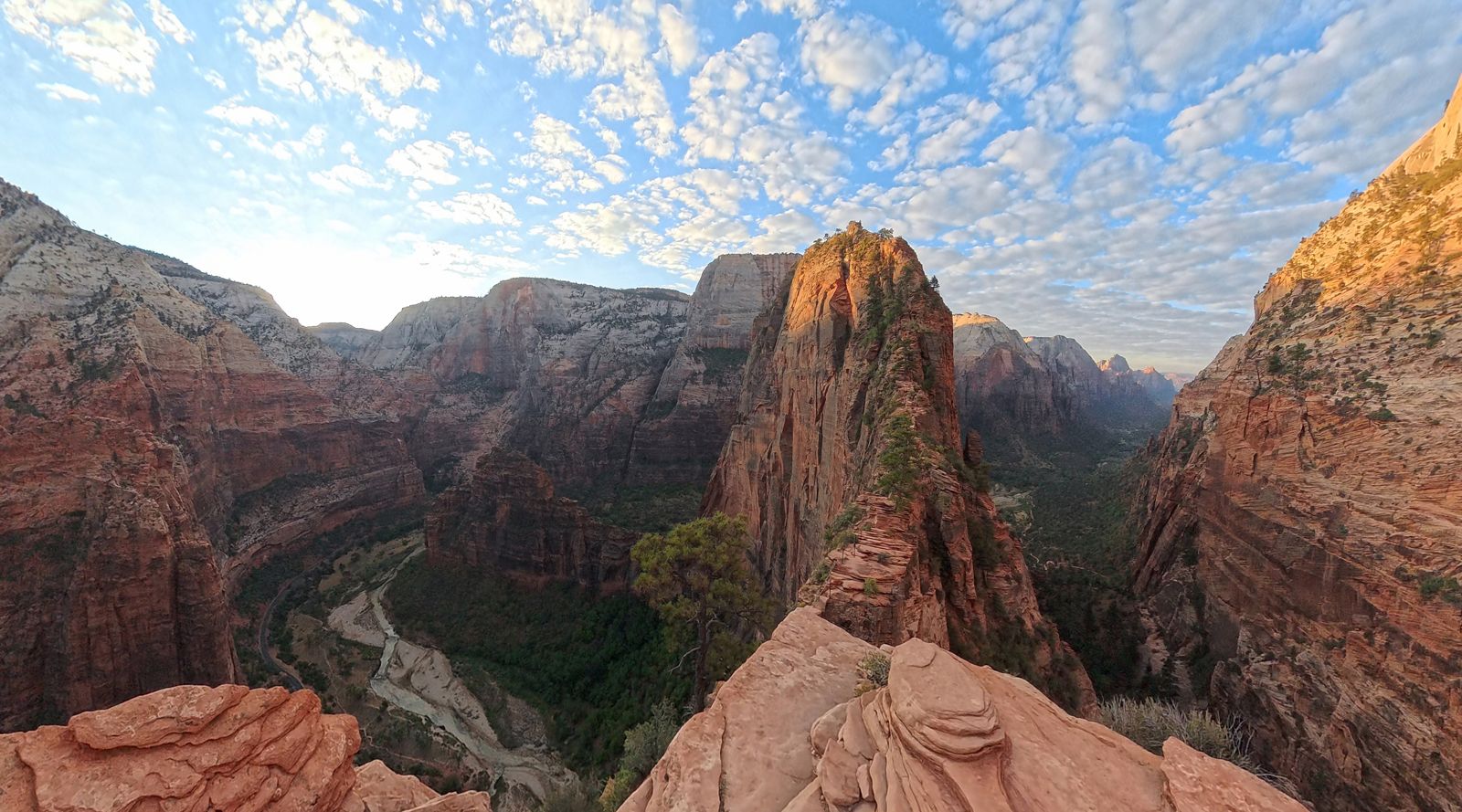
Angels Landing is one of the most popular destinations in Zion, and since the pilot permit program began, everyone who hikes it needs a permit. The permit covers the chains section from Scout Lookout to the summit. You do not need a permit to hike up to Scout Lookout.
There are two ways to get one, both through recreation.gov.
The seasonal lottery
You apply months in advance, picking and ranking seven days and times (or windows of days and times). The windows, as the park published them on October 8, 2026:
| Hike dates | Lottery opens, 8 am MT | Lottery closes, 11:59 pm MT | Permits issued |
|---|---|---|---|
| March 1 - May 31 | January 1 | January 20 | January 25 |
| June 1 - August 31 | April 1 | April 20 | April 25 |
| September 1 - November 30 | July 1 | July 20 | July 25 |
| December 1 - February 28 (next year) | October 1 | October 20 | October 25 |
As of late October 2026, the winter window has closed; the next one, for hikes from March 1 to May 31, opens on January 1.
The day-before lottery
If you missed the seasonal window, or your dates changed, the day-before lottery opens every day at 12:01 am and closes at 3 pm Mountain Time for a hike the following day. Permits are issued at 4 pm, and results are sent after 4 pm. To hike on a Tuesday, you apply on Monday. Applying early in the window does not help: everyone who applies while it is open has the same odds.
What it costs
- $6 to apply, for an application covering up to 6 people including you. The application fee is non-refundable.
- $3 per person if you are picked; recreation.gov emails a confirmation and a receipt for the permit fee.
Changes and cancellations
- Seasonal permits can be cancelled until two days before the hike, with a refund of the $3 per-person fee (not the $6 application fee). You can also reduce the group size until then. Cancelled seasonal permits roll over to the day-before lottery.
- Day-before permits cannot be changed, and all fees are non-refundable.
- No permit can be transferred. You cannot change the date, add people, transfer the permit or change to an alternate leader.
On the day
The time on your permit is when you need to be at the Grotto, Shuttle Stop 6, where most hikers start. Print or download the confirmation email before you set out: it is your permit, phone service at the checkpoint is unreliable, and rangers may check it at the Grotto, at Scout Lookout or anywhere on the trail.
The hike is 5.4 miles round trip with 1,488 feet of elevation gain, and most hikers take around 4 hours. The last half mile follows a single metal chain along a knife-edge ridge; since 1930, most of the deadly accidents on the route have happened there. The park advises against going up when storms are around, when the rock is wet or icy, when it will be dark before you finish, or if you have any fear of heights. Water is available at the Grotto and nowhere else on the trail; the park suggests every person drink 1 gallon (4 liters) a day.
If you do not get a permit, Scout Lookout is still worth the climb. You cover most of the distance and elevation of the full hike, with views over Angels Landing and Zion Canyon.
The Narrows: when you need a permit
The Narrows is the narrowest part of Zion Canyon, a gorge with walls 1000 feet tall and the Virgin River sometimes only 20-30 feet wide. There are two ways to hike it, and only one needs a permit.
Bottom-up: no permit
From the Temple of Sinawava (Shuttle Stop 9), the paved Riverside Walk runs 1 mile to the point where you step into the river. From there you can wade upstream as far as Big Spring, a 9.4-mile out-and-back trip, without a permit. The park lists it as up to 4.7 miles one way, 334 feet of elevation and anywhere from 1 to 8 hours. Most people go for an hour or two and turn around.
The limits on the bottom-up route:
- Big Spring is the end. Upstream travel in the river beyond Big Spring is not allowed.
- Orderville Canyon only for 1/4 mile. The side canyon joins about two miles up; you may explore up to 1/4 mile of it from below.
- Groups of 12 at most above the Orderville Canyon junction.
- No tubes. Recreational inflatable tubes are not allowed on any watercourse in the park.
Top-down: wilderness permit
The 16-mile through-hike from Chamberlain’s Ranch to the Temple of Sinawava needs a wilderness permit, whether you do it in a single day or over two days with a night at one of the 12 campsites in the canyon. The park lists 16 miles one way, 1,300 feet of elevation and 10-14 hours of hiking, with at least 80% of the route spent in the river. Permits must be obtained in person at the wilderness desk in the Zion Canyon Visitor Center, open 8 am to 5 pm, and you arrange your own transport to the trailhead, a 1.5-hour drive from Zion Canyon.
When The Narrows closes
A permit, or no permit, does not help if the river is too high. The park’s thresholds:
- Below 70 CFS, walking is moderately difficult, with knee-deep crossings and pools up to waist-deep.
- Between 70 and 150 CFS, crossings are often thigh-deep and pools can be chest-deep.
- Above 150 CFS, The Narrows closes to all travel. Top-down trips close earlier, above 120 CFS.
- Flash Flood Warnings close The Narrows too, and it stays closed for at least two hours after a warning is lifted.
Spring snowmelt is the usual culprit. In 2024 the river ran above 150 CFS from April 11 to May 19, and in 2023 from April 8 to June 19; in 2025 and 2026 it was open most of the time. Most people hike in summer and early fall, when the water is lowest and warmest, but flash floods are more frequent in the July-September monsoon.
Canyoneering, the Subway and other wilderness permits
Over 124,400 acres of Zion are designated wilderness. A wilderness permit is required for all technical canyoneering trips, and the Subway and the top-down Narrows need permits too. One rule matters if you are thinking of hiring a guide for any of these: the park prohibits structured or guided activities run by commercial or other organizations in its Wilderness areas. They are allowed only on frontcountry trails.
Opening hours
There is no opening time to plan around. The park is open 24 hours a day, 7 days a week, year-round. What has hours is everything around it:
- Zion Canyon Visitor Center information desk: 8 am - 5 pm.
- Wilderness desk, for top-down Narrows and other wilderness permits: 8 am - 5 pm.
- The shuttle: from September 13 to October 24, 2026, the first bus leaves the visitor center at 7:00 am and the last one out of the canyon leaves the Temple of Sinawava at 7:15 pm; from October 25 to November 28 it is 7:00 am and 6:15 pm; there is no service from November 29 to December 25.
Our guide to getting there from Las Vegas and St. George has the full shuttle table and the parking options.
Do tours include the fees and permits?
It depends on the tour, and it is the first thing to check:
- Entrance fee. Check whether the price includes the vehicle fee or lists it as an extra, and remember that the $100 nonresident fee is charged per person on top.
- Angels Landing. No tour can get you onto the chains without a permit from the lottery.
- The Narrows. A guided trip can only use the frontcountry: guided activities are not allowed in Zion’s Wilderness areas.
Our tours compared guide goes through each kind of tour and what it actually covers.
Frequently asked questions
How much is the Zion entrance fee?
$35.00 per private vehicle, $30.00 per motorcycle and $20.00 per person on foot or by bike, valid for 7 days, on the fee page updated June 6, 2026. Youth 15 and under are free.
Do foreign visitors pay more at Zion?
Yes. Each non-US resident aged 16 and older pays a $100 nonresident fee on top of the entrance fee, including on tours, unless they hold an annual or America the Beautiful pass.
Do you need a ticket or timed entry for Zion?
No. You do not need a permit or reservation to enter the park or ride the shuttle.
How much does an Angels Landing permit cost?
$6 to apply, for up to 6 people, plus $3 per person if you are selected.
Do you need a permit to hike The Narrows?
Not from the bottom up, as far as Big Spring. The 16-mile top-down hike from Chamberlain’s Ranch needs a wilderness permit.