Nature
Hiking Zion National Park: The Narrows, Angels Landing and the Best Trails
Hiking is what most people come to Zion for. The park’s trails run from paved riverside strolls to a knife-edge ridge with chains and a river you walk up instead of beside. The National Park Service sorts the Zion Canyon trails into three groups: easy hikes of 0.4 to 3.5 miles that gain no more than 100 feet, moderate hikes of 1 to 7.6 miles with bigger climbs, and strenuous hikes of 2.5 to 9.4 miles with elevation gains of up to 2,148 feet. Most start from a stop on the park shuttle, and most need no permit; Angels Landing is the famous exception.
This article goes through the main trails with the park’s own figures for distance, climb and time, then covers The Narrows, the quieter trails of Kolob Canyons, and the safety rules that matter most in a desert canyon. Distances below are one way unless they say round trip.
Before you start: the shuttle and the trailheads
From March through November, the park says, most Zion Canyon hikes can only be reached on the park shuttle. Shuttles are free, need no ticket, and run up Zion Canyon Scenic Drive from the Zion Canyon Visitor Center; during the season no private cars may use the scenic drive. The trailheads you will use most are:
- Stop 1, Zion Canyon Visitor Center: the Pa’rus Trail and the Watchman Trail.
- Stop 2, Human History Museum: a connector to the Pa’rus.
- Stop 3, Canyon Junction: the other end of the Pa’rus.
- Stop 5, Zion Lodge: the Emerald Pools trails and the Grotto Trail.
- Stop 6, The Grotto: the Kayenta Trail, the West Rim Trail to Scout Lookout, and Angels Landing.
- Stop 7, Weeping Rock: currently closed by rockfall.
- Stop 9, Temple of Sinawava: Riverside Walk and The Narrows.
The full ride from the visitor center to the Temple of Sinawava takes about 45 minutes. Plan your return: the park warns that if you miss the last shuttle, you may have to walk nine miles back. The canyon trails at a glance:
| Trail | Shuttle stop | Distance | Climb | Time |
|---|---|---|---|---|
| Riverside Walk | 9 | 1 mi | 154.2 ft | 1-2 hours |
| Lower Emerald Pool | 5 | 0.6 mi | 131.1 ft | 1-2 hours |
| Middle Emerald Pools | 5 | 2.2 mi round trip | 332.8 ft | 1-2 hours |
| Kayenta Trail | 6 | 0.9 mi | 204.1 ft | 2-3 hours |
| Watchman Trail | 1 | 3.3 mi round trip | 479.4 ft | about 2 hours |
| West Rim to Scout Lookout | 6 | 1.9 mi | 1,187 ft | 3-4 hours |
| Angels Landing | 6 | 5.4 mi round trip | 1,488 ft | about 4 hours |
| The Narrows to Big Spring | 9 | 9.4 mi round trip | 334 ft | 1-8 hours |
Easy hikes in Zion Canyon
These are the walks for a first afternoon, for families, or for a rest day between big hikes.
Pa’rus Trail. “Pa’rus” is Paiute for “bubbling water”. This paved path follows the Virgin River from the visitor center to Canyon Junction, with some of the best views of the Watchman. The park’s bicycling page puts it at 1.75 miles; allow 30 to 120 minutes. It is the only trail in the park open to bicycles and to leashed pets, and it is accessible for wheelchairs. Exhibits along the way cover plants, animals, geology and history, and the park recommends it for sunset and stargazing.
Riverside Walk. At the end of the scenic drive, this paved trail follows the river for 1 mile as the canyon walls close in, ending where The Narrows begin. It is mostly flat for the first half-mile. If you want to stay dry, turn around at the end of the pavement.
Lower Emerald Pool Trail. A rough paved trail of 0.6 miles from Zion Lodge through pinyon-juniper woodland to a pool and seasonal waterfalls. Swimming is not permitted; the pools are a fragile water source for wildlife.
Grotto Trail. A flat, shaded 1.0-mile round trip linking Zion Lodge and The Grotto, good for spotting birds, turkey and deer, and handy for building a loop with the Emerald Pools and Kayenta trails.
Weeping Rock. A short, steep paved trail that gains 98 feet in 0.4 miles to an alcove of dripping springs. In October 2026 the park listed the area as closed due to rockfall.
Moderate hikes
Middle and Upper Emerald Pools. The Middle Emerald Pools Trail climbs steeply from the Lodge onto a sandstone ledge with wide views of the canyon, then drops to pools above the lower falls: 2.2 miles round trip. Upper Emerald Pool lies another 0.3 miles on, up stone steps and sand to a pool at the foot of towering walls, with views of Lady Mountain and the Great White Throne.
Kayenta Trail. From The Grotto, the Kayenta Trail follows the river and climbs to the Emerald Pools trails, with panoramic views and some long drop-offs. Return the same way or make a loop back to the Lodge.
Watchman Trail. Starting at the visitor center, this unpaved trail climbs to a viewpoint over the Watchman, the Towers of the Virgin, lower Zion Canyon and Springdale. It is 3.3 miles round trip and takes about 2 hours on average. There is limited shade in summer, so go early.
Canyon Overlook. On the east side of the park, beyond the Zion-Mount Carmel Tunnel, this 1-mile trail climbs sandstone steps above a dark slot canyon to a fenced viewpoint looking down Zion Canyon. Watch for bighorn sheep. Parking is extremely limited, and the park says you may need to try more than once.
Scout Lookout and Angels Landing
The hike most people have heard of starts at The Grotto, crosses the river and climbs the West Rim Trail. The park describes it as strenuous: steep switchbacks up the canyon wall, a cooler, flatter stretch through Refrigerator Canyon, then Walter’s Wiggles, a series of 21 switchbacks, up to Scout Lookout. The climb is about 1,000 feet, and the hike takes 3 to 4 hours.
Scout Lookout needs no permit. It is a sandy, partly shaded spot with views up and down the canyon, restrooms but no water, and for many people it is the right place to stop. Look for California condors: the park says the endangered birds call these cliffs home.
Angels Landing needs a permit. From Scout Lookout, the final half-mile follows a steep, narrow ridge with steps cut into the rock and chains anchored along the way, with sheer drop-offs of as much as 1,000 feet on each side. The whole hike from The Grotto is 5.4 miles round trip with 1,488 feet of climbing, and most hikers take about 4 hours. The park says that since 1930, most of the deadly accidents on the route have happened on the chains section.
Permits come through recreation.gov by lottery:
- Day-before lottery: apply between 12:01 am and 3 pm Mountain Time the day before your hike; results come after 4 pm.
- Seasonal lottery: apply months ahead, ranking up to seven days or windows. For hikes from December 1 to February 28, applications close on October 20.
- Cost: $6 to apply, covering up to 6 people, plus $3 per person if you win a permit.
The park’s advice: do not go on if storm clouds are around, if the rock is wet or icy, if it will be dark before you finish, or if you have any fear of heights. The name, the park says, goes back to Frederick Vining Fisher, a Methodist minister who visited in 1916 and is said to have remarked that only an angel could land there. Our guide to Zion tickets and permits covers how the lottery fits into planning a trip.
The Narrows
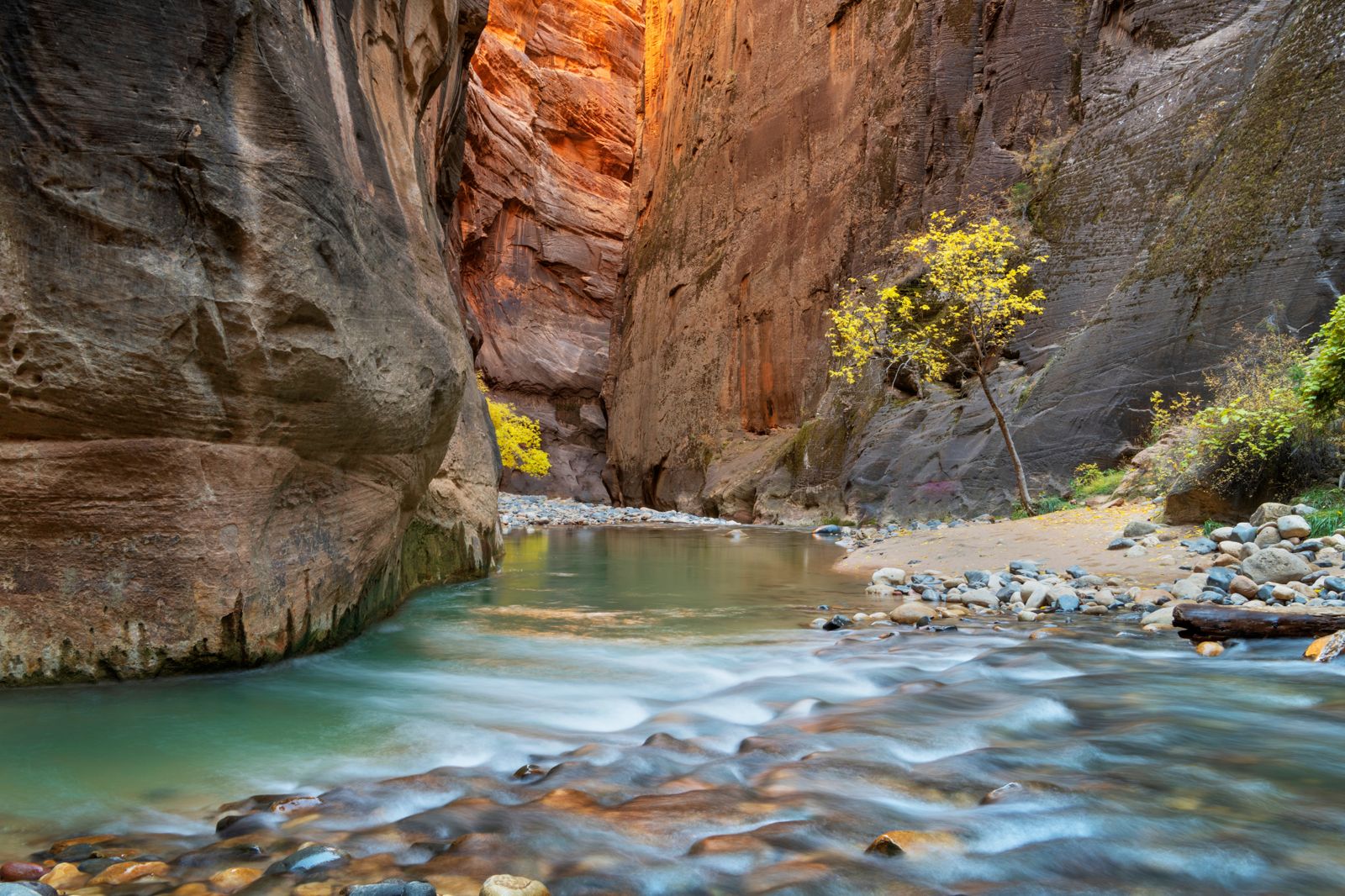
The Narrows is the narrowest section of Zion Canyon: a gorge with walls 1,000 feet tall where the river is sometimes only 20 to 30 feet wide. After the 1-mile Riverside Walk, you step into the Virgin River, and from then on the river is the trail.
Bottom-up, no permit. From the Temple of Sinawava you can wade upstream as far as Big Spring, a 9.4-mile out-and-back trip, or turn around whenever you like. There is no single viewpoint; the park says the hike is “about the journey, not the destination”. At least 60% of the hike is spent wading, walking and sometimes swimming, in cold, fast water over large, slippery boulders. Orderville Canyon, a side canyon about two miles up, can be explored for its first quarter-mile.
Top-down, permit required. The 16-mile through-hike from Chamberlain’s Ranch to the Temple of Sinawava needs a wilderness permit, and you arrange your own transport to the start.
Water levels decide everything. Below 70 cubic feet per second (CFS) the walking is moderately difficult, with knee-deep crossings; from 70 to 150 CFS it gets challenging, with thigh-deep crossings and chest-deep pools; over 150 CFS The Narrows close. They also close during flash flood warnings. Our article on Zion weather and the best time to visit has the season-by-season picture.
Gear. Closed-toe shoes and a walking stick; never sandals or bare feet. In cold months many hikers wear drysuits or waders. The park does not rent gear, but outfitters near the park do, and guided Narrows hikes are listed on the tours page.
Kolob Canyons: Zion without the crowds
Kolob Canyons, in the northwest corner of the park, is about an hour from Zion Canyon and has no shuttle. You reach it from Exit 40 on Interstate 15, and a five-mile scenic drive leads past 2,000-foot cliff walls to the trailheads. The park counts over 20 miles of hiking trails here, and pets are not allowed on any of them.
- Timber Creek Overlook: a short ridge walk of 0.6 miles to views of Shuntavi Butte, the Kolob Terrace and the Pine Valley Mountains, taking 30 to 60 minutes. On a clear day you may see Mount Trumbull on the Grand Canyon’s north rim, 100 miles away. Wildflowers cover it in spring and early summer.
- Taylor Creek Trail: 2.6 miles up a narrow box canyon to the Double Arch Alcove, past two homestead cabins built in the early 1930s, crossing the creek again and again. Allow 3 to 4 hours.
- La Verkin Creek Trail to Kolob Arch: a long day of 7 to 9 hours, 14 miles in all, from Lee Pass to a viewpoint of Kolob Arch. With a span of 287 feet, the park calls it one of the world’s largest natural arches.
Groups larger than 12 may only use the Timber Creek Overlook Trail in Kolob Canyons, because the other trails are in designated wilderness.
Trails for families and limited mobility
Not every Zion hike involves chains or wading. The Pa’rus Trail is paved, with gentle grades, and is accessible for wheelchairs; the park measured its typical grade at 2.6%. Riverside Walk is paved concrete and mostly flat for its first half-mile, though paving is irregular in places. The Grotto Trail is relatively flat and shaded, and the Lower Emerald Pool Trail is paved but rough, with some steeper sections.
The park publishes surface, width and grade measurements for each of these trails on its trail pages, and a Trail Access Information page for planning with a wheelchair or stroller. For children, the safest rule is the park’s own: watch them closely anywhere near a cliff edge, and turn around early.
Rules on the trail
A few park rules catch out first-time visitors:
- Pets are allowed only on the Pa’rus Trail, on a leash no longer than 6 feet.
- Bicycles, including Class 1 pedal-assist e-bikes, are allowed only on the Pa’rus and park roads, never on other trails or through the Zion-Mount Carmel Tunnel.
- Wilderness permits are needed for overnight trips, the top-down Narrows, the Subway and all technical canyoneering.
- Group size in the wilderness is limited to 12 people.
- Waste: there are no trash cans on the Angels Landing trail, and you must pack out human waste.
Staying safe on Zion’s trails
The park is blunt: “your safety is your responsibility”, and rangers respond to numerous rescues each year, many of them preventable.
- Water and heat. Carry at least one gallon of water per person per day. On Angels Landing, The Grotto is the last place to fill up.
- Flash floods. They can strike under sunny skies, from storms miles away, and are most frequent in the July-to-September monsoon. Check the flash flood potential before entering The Narrows or any slot canyon.
- Cliffs. Falls from cliffs on trails have resulted in death. Stay on the trail and back from edges, and never throw or roll rocks.
- Rockfall. If you see one, move away from the cliff; if you cannot, shelter behind a large boulder with your pack over your head.
- Hypothermia. It is a major hazard in narrow canyons, even in warm weather. Avoid cotton.
- Ice. In winter, shaded trails such as Riverside Walk and the Lower Emerald Pool Trail can be icy.
Hiking with a guide
The park’s rangers do not lead tours of Angels Landing, but permitted local businesses guide hikes in and around Zion. A guided trip can make sense for The Narrows, where outfitters supply the drysuits, shoes and poles, and for canyoneering, which the park describes as route finding, rappelling, swimming and hiking in dozens of canyons. Outside the wilderness, e-bike tours are another way to cover the scenic drive and the Pa’rus. Our guide to Zion tours compared sets the options side by side, and bookable trips are on the tours page.
Planning your hiking days
- Half a day: Pa’rus Trail in the early morning, then the shuttle up to Riverside Walk.
- One full day: the Emerald Pools loop via the Kayenta Trail in the morning, then the first part of The Narrows in the afternoon, water levels permitting.
- Two days: Scout Lookout (or Angels Landing with a permit) at sunrise on day one, a long Narrows hike on day two.
- A quiet day: Kolob Canyons, with Timber Creek Overlook and the Taylor Creek Trail.
- On the way east: Canyon Overlook, early, before the small parking area fills.
Frequently asked questions
What is the best hike in Zion?
It depends on your nerve and fitness. Angels Landing has the most famous views but needs a permit and a head for heights; The Narrows is the most unusual; Scout Lookout and the Emerald Pools give big views with less exposure.
Do you need a permit to hike in Zion?
Not for most day hikes. You need a permit for Angels Landing, the top-down Narrows, the Subway, technical canyoneering and overnight trips. Scout Lookout and The Narrows from the bottom up need none.
How long is the Angels Landing hike?
5.4 miles round trip from The Grotto, with 1,488 feet of climbing. Most hikers take about 4 hours.
Can you hike The Narrows without a permit?
Yes, from the bottom up, as far as Big Spring. The 16-mile top-down hike from Chamberlain’s Ranch needs a wilderness permit.
What is the easiest hike in Zion?
The Pa’rus Trail and Riverside Walk are both paved and mostly gentle. The Grotto Trail is a flat 1.0-mile round trip.
Can I bring my dog hiking in Zion?
Only on the Pa’rus Trail. Pets are not allowed on any other trail, in the wilderness or on the shuttle.